AI Isn't the Crisis. Your Feed Is.
While everyone debates AI risk, a more immediate crisis is already reshaping human behavior: the media environment itself. Here's why the medium matters more than the machine.

Every week there's a new headline about AI threatening humanity. Job displacement. Superintelligence. Existential risk.
Maybe those concerns will prove legitimate. But AI is still a question mark. The outcomes are speculative. The timelines are uncertain.
Meanwhile, something else is already happening. Something with documented, measurable effects on human behavior, mental health, and society.
It's not artificial intelligence. It's media itself.
I'm not talking about misinformation or fake news. I'm talking about the broader environment we now inhabit: algorithmically curated feeds, personalized content streams, and attention-harvesting systems that shape how we perceive reality.
The crisis isn't what the media says. It's what the media does to us simply by existing in its current form.
The Medium Is the Message
Marshall McLuhan wrote in 1964 that "the medium is the message." His insight: the characteristics of a communication medium shape human perception more profoundly than the content transmitted through it.
He used the example of electric light. Light contains no content—no news, no opinions. Yet it restructured human life by enabling nighttime activity and reorganizing social patterns. The medium itself produced consequences independent of any message.
Apply that to algorithmic social media. The platform doesn't just deliver content—it shapes how we think, what we attend to, and how we relate to others.
The notifications. The infinite scroll. The variable reward schedules. The quantified feedback through likes. These structural features operate on us constantly, regardless of what specific content flows through them.
And the effects aren't subtle anymore. They're measurable.
The Numbers
A randomized controlled trial published in November 2025 examined what happens when young adults reduce social media use for one week.
Anxiety symptoms dropped 16.1%. Depression dropped 24.8%. Insomnia dropped 14.5%.
One week.

The U.S. Surgeon General's Advisory found that adolescents spending more than three hours daily on social media face double the risk of poor mental health outcomes.
A longitudinal study tracking 11,000 children found that increased social media use predicts subsequent depressive symptoms. The reverse wasn't true—depression didn't predict increased social media use. The causation runs one direction.
The 2023 CDC Youth Risk Behavior Survey: 40% of high schoolers report persistent sadness or hopelessness. Among girls, 53%. Among LGBTQ+ youth, 65%.
Research from Karolinska Institutet following 8,000 children found social media use predicted inattention symptoms—but television and video games didn't show the same effect. Something specific about social media's constant distractions creates ongoing interference with sustained attention.
This isn't correlation. We're seeing causal evidence from experimental designs and longitudinal studies.
Want More Digital Insights?
Subscribe to get philosophy pieces and practical strategies delivered to your inbox.
We respect your privacy. Unsubscribe at any time.
Industrialized Persuasion
James Williams, former Google advertising strategist turned Oxford philosopher, argues we're living through a crisis of attention itself.
The attention economy concentrates unprecedented power in a few technology companies. Their business models depend on systematically capturing human attention and directing it toward commercial objectives.
Shoshana Zuboff, who coined "surveillance capitalism," frames this as a threat to autonomy. The shift isn't just from observing behavior to predicting it—it's from predicting to actuating. Subtle cues nudge users toward outcomes that maximize corporate profit.
Users retain the subjective sense of making free choices while inhabiting an engineered environment that shapes those choices.
The dopamine mechanisms are comparable to substance addiction. Social media activates reward pathways through variable reward schedules—the same mechanism that makes slot machines addictive.
The Reality Distortion
For nearly three decades, more than 60% of Americans have told Gallup pollsters that crime is rising.
FBI statistics show violent crime dropped nearly 50% since 1993.
How does this perception-reality gap persist for 30 years? Media coverage. Research shows homicides account for 61% of crime coverage in some outlets despite representing a tiny fraction of actual crimes.
Disproportionate attention to violent crime—combined with minimal contextualizing information—creates a "cultivation effect" where heavy media consumers develop distorted perceptions.
Research on mass shootings found evidence of temporal clustering—one high-profile shooting increases the probability of subsequent shootings for up to 13 days. Media coverage provides a "salient behavioral model" for at-risk individuals.
Violence is over-represented in coverage. Over-representation shapes perception. Distorted perception influences behavior. Behavior generates more coverage.
The feedback loop is the crisis.
Why You Can't Escape
Media is deeply tied to capitalism in ways that make it nearly impossible to avoid for anyone trying to make an income.
Creators need platforms to reach audiences. Businesses need digital marketing. Job hunters need LinkedIn. Professionals need to be reachable across channels.
The systems that fragment attention are the same systems through which economic opportunity flows.
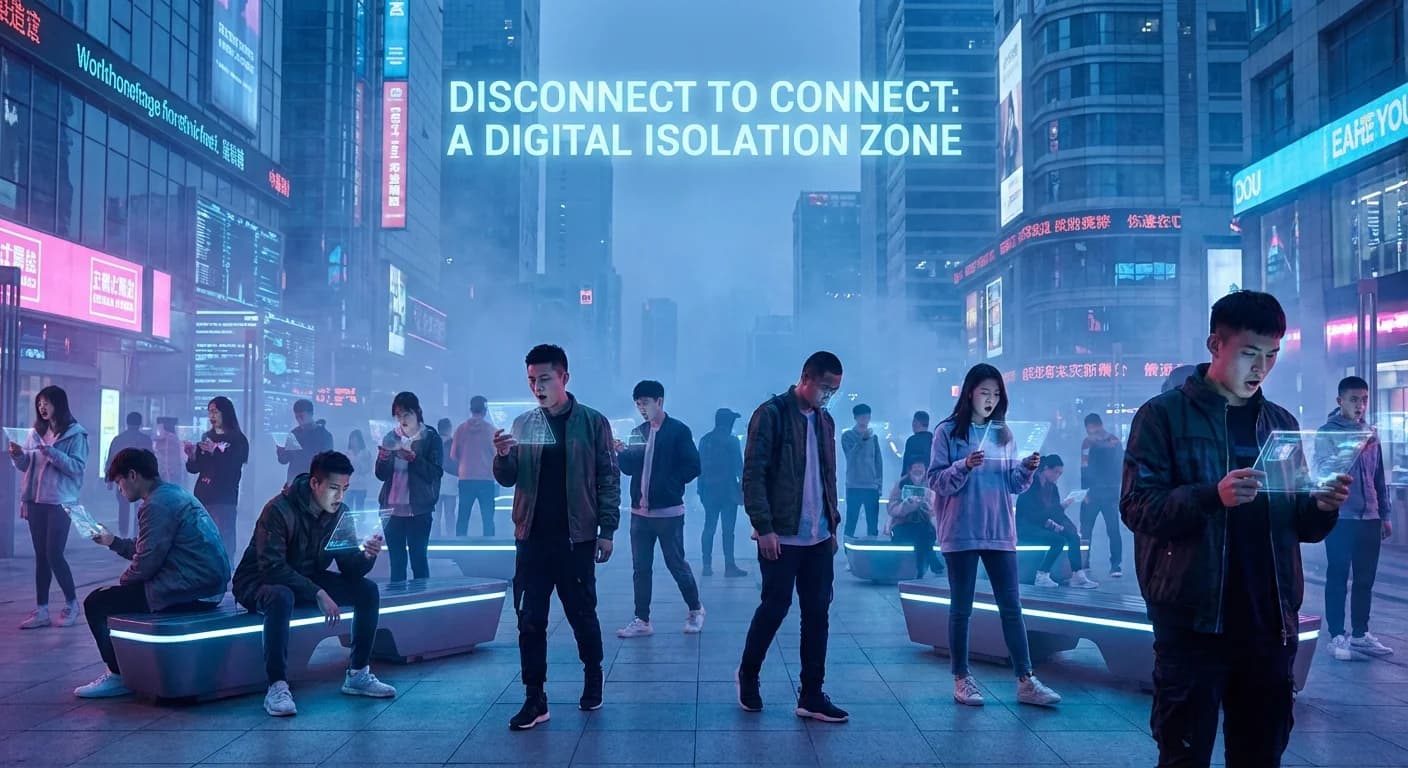
This isn't a conspiracy. It's a natural market outcome. Companies that capture more attention make more money. Companies that make more money invest more in attention capture. Competitive dynamics create a race to the bottom.
At MuseMouth, I work with businesses on AI implementation and digital strategy. I'm not suggesting you can opt out—that's not realistic. But understanding the dynamics matters for making conscious choices.
What Future Historians Might Say
A hundred years from now, if humans navigate this successfully, what will historians call the early 21st century?
Maybe the Media Hellhole Era. The Wall-E period. The time when billions became absorbed in curated digital realities while physical communities atrophied, attention spans collapsed, and mental health deteriorated across generations.
Or maybe there will be a cultural split. Some populations finding healthy relationships with technology while others descend into algorithmic escapism.
AI risk discourse focuses on speculative future threats while the demonstrable crisis of attention capture remains insufficiently addressed. The infrastructure of persuasion already surrounds us—and future AI will operate on top of it.
Question Mark vs. Fact
AI is a question mark. Uncertain outcomes. Debated timelines. Speculative risks.
Media's effects are documented facts. Longitudinal studies. Randomized controlled trials. Causal evidence. The crisis is happening now.
And here's the intersection: AI is being developed primarily by companies whose business models depend on attention capture. Whatever AI becomes, it will likely amplify the media systems already reshaping human cognition.
Maybe the most important question isn't whether AI will become dangerous. Maybe it's whether we can navigate the media environment we've already created—before we hand it more powerful tools.
The feed isn't going away. The question is whether we recognize what it's doing while we still have the attention span to respond.
Want More Philosophy & Strategy?
Subscribe to get thought pieces and implementation strategies delivered to your inbox.
We respect your privacy. Unsubscribe at any time.
Check Out My Content Creation Tools
I build tools that solve real content creation problems. From AI-assisted blogging to custom song lyrics, many have free trials so you can see the results firsthand.
Explore My Tools →